
- 日期:2026-09-20
- 分類:企業
What Is a Pneumatic Grease Pump?
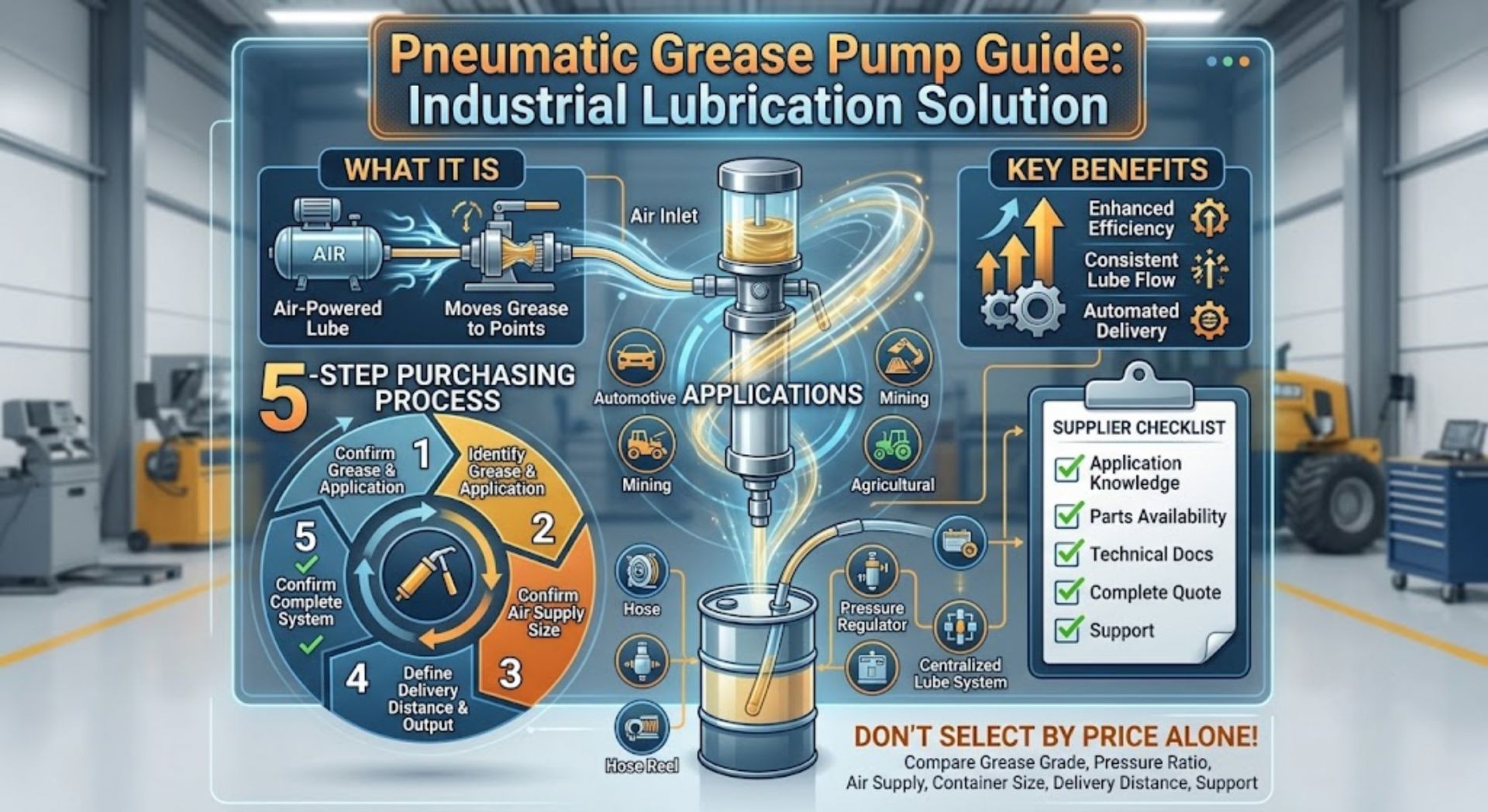
A pneumatic grease pump is a lubrication pump driven by compressed air. Instead of requiring an operator to manually pump grease, compressed air powers the pump mechanism and creates the pressure needed to move grease from a container through a lubrication line.
Pneumatic grease pumps are particularly useful when grease must be delivered frequently, over a longer hose distance, to multiple lubrication points, or at pressures that would be inconvenient with a manual pump. They can be connected to grease guns, hose reels, dispensing valves, distribution lines, or automated lubrication equipment depending on the application.
The basic system normally includes an air motor, pump tube, grease container or drum connection, air regulator or filter components, grease outlet, delivery hose, and dispensing equipment. Optional accessories may include follower plates, drum covers, hose reels, pressure regulators, control valves, fittings, mobile carts, and centralized lubrication components.
Selection Tip: Do not choose a pneumatic grease pump only by looking at maximum pressure. The correct pump should match the grease, air supply, delivery distance, expected flow, hose diameter, operating frequency, drum size, and lubrication system design.
Where Pneumatic Grease Pumps Are Commonly Used
Pneumatic grease pumps are used wherever machinery requires frequent or high-pressure grease lubrication. They are particularly suitable for facilities that already have a compressed-air supply and need a more efficient alternative to manual grease handling.
Automotive and Fleet Service Workshops
Vehicle maintenance facilities may use air-operated grease pumps to lubricate chassis components, bearings, joints, pins, bushings, and other service points. A drum-mounted system with a hose reel can help technicians access multiple work bays while reducing repeated manual pumping.
Manufacturing and Machinery Maintenance
Production plants often require scheduled lubrication for bearings, slides, gears, conveyors, presses, and other moving equipment. A pneumatic grease pump can support routine maintenance or feed grease into a centralized lubrication network.
Construction, Mining, and Heavy Equipment
Excavators, loaders, cranes, mining equipment, and other heavy machinery often contain large pins, bushings, and bearings exposed to dirt, moisture, vibration, and heavy loads. These applications may require reliable grease delivery and sufficient pressure to overcome resistance in long hoses or restricted lubrication passages.
Agricultural and Transportation Equipment
Farms, transportation fleets, logistics facilities, and equipment service centers can also use pneumatic grease pump systems to reduce lubrication time across tractors, trailers, lifting equipment, agricultural machinery, and service vehicles.
First-Time Pneumatic Grease Pump Purchasing Process: 5 Steps
First-time buyers often focus on pump ratio or price, but a better purchasing process begins with the actual lubrication requirement. The following five steps can help reduce specification errors.
Step 1: Identify the Grease and Application
Start by identifying the grease type, approximate NLGI grade, operating temperature, machine type, lubrication points, and expected working environment. Grease consistency can significantly affect pump selection, especially under cold conditions or when long delivery lines are involved.
Step 2: Confirm Your Compressed-Air Supply
Check available air pressure, air volume, connection size, air quality, and whether the system has suitable filtration and regulation. A pump cannot perform correctly if the available compressed-air supply does not meet its operating requirements.
Step 3: Define Delivery Distance and Required Output
Tell the supplier how far the grease must travel, the approximate hose size, the number of dispensing points, and whether multiple operators may use the system. Long hoses, narrow passages, cold grease, and multiple outlets may increase system resistance.
Step 4: Match the Pump to the Grease Container
Pneumatic grease pumps are available for different container sizes, including pails, kegs, drums, and bulk systems. Pump tube length, drum cover size, follower plate dimensions, and mounting method should match the actual grease container used at the facility.
Step 5: Confirm the Complete System Before Ordering
Ask whether the quotation includes only the bare pneumatic grease pump or a complete package. Depending on your project, you may also need an air regulator, drum cover, follower plate, grease hose, hose reel, swivel, grease gun, fittings, cart, shut-off valve, and other accessories.
How to Choose a Pneumatic Grease Pump Supplier: 6 Points to Check
Choosing the right supplier is just as important as choosing the pump itself. A pneumatic grease pump is part of a lubrication system, so the supplier should understand more than a model number.
- Check whether the supplier asks about the application: A qualified supplier should ask about grease grade, operating environment, required pressure, air supply, hose distance, container size, and expected duty cycle.
- Avoid selecting by pressure ratio alone: A higher pump ratio does not automatically mean a better choice. Excessive pressure capability may be unnecessary for short-distance dispensing, while an undersized pump may struggle in demanding applications.
- Confirm replacement parts availability: Seals, air motor components, pump tube parts, fittings, hoses, and service kits may eventually require maintenance or replacement.
- Ask whether technical documentation is available: Installation instructions, dimensional drawings, operating data, compatible grease information, maintenance instructions, and spare-parts information can make future servicing easier.
- Check the complete quotation: Compare what is included instead of comparing only the headline pump price. A low quotation may exclude accessories required for actual operation.
- Evaluate after-sales and technical support: When the system requires troubleshooting, installation guidance, replacement parts, or specification confirmation, responsive support can reduce downtime.
Important Pneumatic Grease Pump Specifications
Technical specifications vary considerably between models. The following items are among the most important when comparing pneumatic grease pump options.
| Specification | Why It Matters |
|---|---|
| Pump Pressure Ratio | Indicates the relationship between air pressure applied to the pump and theoretical fluid pressure capability. The appropriate ratio depends on the system resistance and application. |
| Air Operating Range | Must match the compressed-air supply available at the site. |
| Grease Compatibility | The pump should be suitable for the grease consistency, formulation, and operating temperature used in the application. |
| Flow or Output | Affects how quickly grease can be delivered and whether the pump is suitable for single-point dispensing or larger distribution systems. |
| Container Size | Determines the required pump tube, drum cover, follower plate, mounting arrangement, and overall installation design. |
| Inlet and Outlet Connections | Connections must match the air supply, hoses, fittings, valves, reels, and other system components. |
| Duty Cycle | Continuous industrial use can require a different pump configuration than occasional workshop dispensing. |
Pressure ratios found in industrial pneumatic grease pump systems can vary substantially. For example, manufacturers offer configurations such as 50:1, 70:1, and other higher-ratio designs for different lubrication requirements. The correct ratio should therefore be selected according to the complete lubrication circuit rather than simply choosing the highest number available.
What Affects Pneumatic Grease Pump Cost?
Buyers searching for a pneumatic grease pump price will find that quotations can vary significantly. This does not necessarily mean one supplier is expensive and another is cheap. Different quotations may include completely different specifications and accessories.
| Cost Factor | Possible Impact |
|---|---|
| Pump Capacity and Ratio | Heavy-duty pumps designed for demanding applications may cost more than basic workshop models. |
| Drum or Container Configuration | Different drum sizes require compatible pump tubes, covers, follower plates, and mounting components. |
| Hose and Reel System | Longer hoses, high-pressure hose reels, swivels, and dispensing handles add to the complete system cost. |
| Air Preparation Components | Regulators, filters, shut-off valves, gauges, and related components may be required for a reliable installation. |
| Materials and Construction | Pump materials, seal design, component quality, and intended operating environment can affect pricing. |
| Technical and After-Sales Support | Documentation, spare parts, warranty terms, installation support, and service capability can affect long-term value. |
For this reason, it is better to request a detailed quotation rather than asking only, “How much is a pneumatic grease pump?” A useful quotation should clearly identify the pump model, performance specification, container compatibility, included accessories, optional accessories, delivery terms, warranty conditions, and replacement-part availability.
Installation and Maintenance Considerations
Even a correctly selected pneumatic grease pump can perform poorly if the installation is not appropriate. Air lines should be sized correctly, system pressure should remain within the manufacturer's specified range, and grease hoses and fittings should be suitable for the working pressure of the system.
Clean compressed air is also important. Moisture, contamination, or improper air preparation can reduce the reliability of pneumatic components. Buyers should follow the manufacturer's recommendations for air filtration, lubrication where applicable, pressure regulation, and maintenance intervals.
During operation, technicians should check for unusual air leakage, reduced grease delivery, irregular cycling, hose damage, loose fittings, or pressure changes. Problems should be investigated rather than compensating by continuously increasing air pressure.
- Keep grease containers covered and protected from contamination
- Inspect hoses and fittings for damage or leakage
- Use compatible replacement seals and service parts
- Check the air regulator and filter condition regularly
- Avoid exceeding the manufacturer's rated air or fluid pressure
- Follow documented maintenance and troubleshooting procedures
How Different Industries Choose Pneumatic Grease Pump Configurations
Small Workshop
A small workshop may only require one grease drum, one pneumatic grease pump, a short delivery hose, and a grease gun. Portability and ease of maintenance may be more important than very high flow capacity.
Fleet Maintenance Facility
A fleet service center may need longer hose runs or hose reels so technicians can lubricate vehicles across several service positions. Pump output, working pressure, hose configuration, and grease drum capacity should therefore be considered together.
Manufacturing Plant
A manufacturing plant may require a pneumatic grease pump to feed a lubrication manifold or centralized distribution system. In this case, the supplier may need information about pipe length, number of lubrication points, grease consumption, machine layout, and required operating cycle.
Heavy Equipment Maintenance
Heavy equipment applications often involve larger lubrication points, outdoor conditions, longer hoses, and demanding grease delivery requirements. Selecting the complete system based on actual field conditions is especially important.
What Information to Prepare Before Requesting a Pneumatic Grease Pump Quote
The more information you provide to the supplier, the easier it is to recommend an appropriate pneumatic grease pump. Instead of sending only the keyword “pneumatic grease pump,” prepare the following details whenever possible.
- Grease type and NLGI grade
- Grease container or drum size
- Available compressed-air pressure
- Required hose or pipe length
- Approximate number of lubrication points
- Required flow or dispensing frequency
- Indoor or outdoor operating environment
- Whether a hose reel is required
- Whether the pump will be stationary or mobile
- Any required certifications, connection standards, or special accessories
Providing these details helps suppliers compare the actual operating requirement with pump performance instead of recommending a model based only on a general description.
Before Purchasing: Request a specification review for your application and compare the complete pneumatic grease pump system, not only the pump body. Matching the pump, air supply, grease, hose, fittings, container, and dispensing equipment can help create a more practical lubrication setup.
Pneumatic Grease Pump FAQ
Q1: What is a pneumatic grease pump?
A pneumatic grease pump is an air-powered pump used to move grease from a container or reservoir through hoses, dispensing equipment, or lubrication lines to machinery lubrication points.
Q2: What industries commonly use pneumatic grease pumps?
Common applications include automotive service, fleet maintenance, industrial machinery, manufacturing, construction equipment, mining machinery, agriculture, transportation, and centralized lubrication systems.
Q3: How do I choose the correct pneumatic grease pump ratio?
The correct pump ratio depends on grease consistency, air pressure, delivery distance, hose size, lubrication-point resistance, operating temperature, and required flow. The highest ratio is not automatically the best choice.
Q4: Can a pneumatic grease pump handle NLGI 2 grease?
Many industrial pneumatic grease pumps are designed for grease up to NLGI 2, but compatibility depends on the individual pump model, temperature, system design, and grease formulation. Always confirm the manufacturer's specification before ordering.
Q5: What compressed-air supply does a pneumatic grease pump need?
Air requirements vary by model. Check the specified operating air-pressure range, required air volume, inlet connection, and recommended air filtration or regulation before installation.
Q6: How far can a pneumatic grease pump deliver grease?
There is no single delivery distance for every system. Actual performance depends on pump ratio, grease consistency, hose diameter, temperature, fittings, flow requirement, and total system resistance. Long-distance systems should be reviewed as a complete lubrication circuit.
Q7: Can I install a pneumatic grease pump on different drum sizes?
Pneumatic grease pumps are available for different pails, kegs, and drums, but the pump tube length, drum cover, follower plate, and mounting hardware must match the selected container.
Q8: How long does pneumatic grease pump installation take?
Installation time depends on whether the project is a simple drum-mounted dispensing system or a larger multi-point lubrication installation. Air piping, hose reels, distribution lines, mounting, testing, and system commissioning can all affect installation time.
Q9: How often does a pneumatic grease pump require maintenance?
Maintenance intervals depend on pump design, operating frequency, air quality, grease type, environment, and manufacturer recommendations. Routine checks should include air preparation components, hoses, fittings, seals, leakage, and pump operation.
Q10: What should I provide when requesting a pneumatic grease pump quotation?
Provide the grease type or NLGI grade, container size, available air pressure, delivery distance, hose requirements, approximate lubrication-point quantity, operating environment, required flow, and any accessories such as a hose reel, cart, follower plate, or grease gun.