
- 日期:2026-09-17
- 分類:企業
What Is a Heavy Duty Door?
A heavy duty door is a door system designed for environments where ordinary residential or light-commercial doors may not provide sufficient durability, structural strength, cycle life, security, or resistance to impact. Heavy duty doors are commonly installed in factories, warehouses, logistics centers, industrial buildings, mechanical rooms, laboratories, commercial facilities, loading areas, and high-traffic entrances.
The term heavy duty does not refer to one single door type. Depending on the project, a heavy duty door may be a reinforced steel swing door, industrial sliding door, automatic sliding system, high-speed door, large motorized door, fire-rated steel door, security entrance, or another engineered access solution. What makes the door "heavy duty" is the combination of structural performance, hardware selection, frame reinforcement, operating frequency, environmental resistance, and expected service life.
For this reason, choosing a heavy duty door should not begin with appearance alone. A door that looks strong may still be unsuitable if its hinges, rollers, motor, frame, locking system, or control components are not designed for the expected load. Before selecting a product, the project team should understand the opening dimensions, traffic flow, cycle frequency, security level, environmental conditions, automation requirements, and maintenance expectations.
Steel Heavy Duty Door vs Industrial Automatic Door: What Is the Difference?
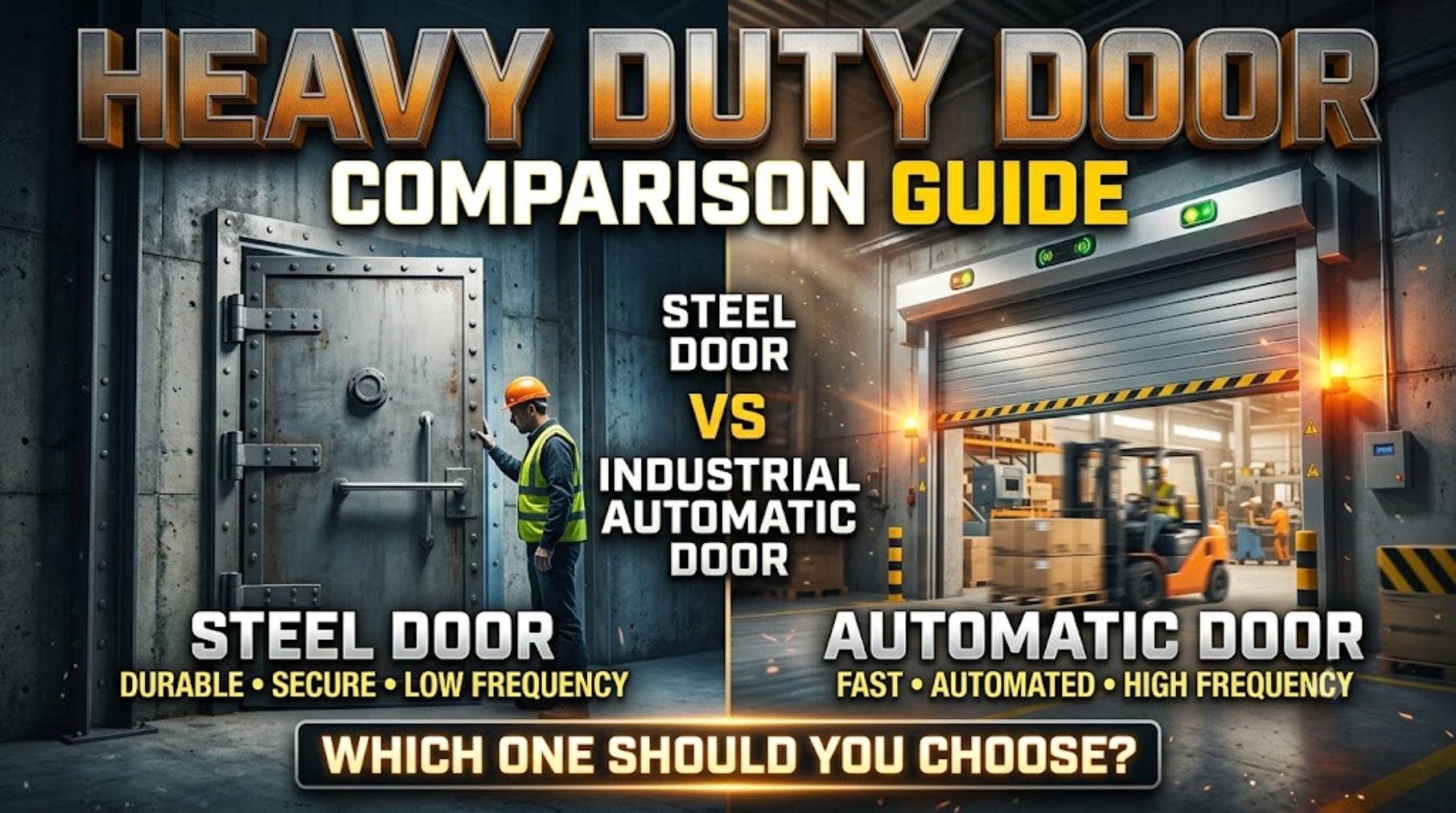
Two of the most common approaches are the reinforced steel heavy duty door and the industrial automatic door. Both can be engineered for demanding environments, but their priorities are different.
Steel Heavy Duty Door
A steel heavy duty door focuses primarily on structural strength, security, durability, and environmental resistance. It may use reinforced steel sheets, internal stiffeners, heavy-duty hinges, stronger frames, high-grade locking hardware, and special coatings for corrosion resistance. This type of door is often selected for utility rooms, plant rooms, exterior service entrances, secure storage areas, factories, industrial facilities, or places where frequent automated opening is not the main requirement.
Industrial Automatic Door
An industrial automatic door places greater emphasis on traffic efficiency, rapid access, automation, sensor control, safety, and operational continuity. Depending on the design, it may use sliding panels, motorized operators, industrial tracks, presence sensors, access control, vehicle loops, remote control, interlocks, or programmable logic. This category is particularly suitable for warehouses, manufacturing lines, logistics facilities, distribution centers, clean manufacturing zones, and entrances with repetitive personnel or vehicle movement.
The key difference is therefore not simply manual versus automatic. The real distinction lies in the project objective. If the priority is strong physical protection and relatively simple operation, a reinforced steel door may be the better fit. If the priority is traffic speed, workflow efficiency, repeated cycles, and integration with building systems, an industrial automatic heavy duty door may be more appropriate.
Heavy Duty Door Comparison Table
| Comparison Item | Steel Heavy Duty Door | Industrial Automatic Door | Best For |
|---|---|---|---|
| Primary Strength | Durability, security, structural strength | Efficiency, automation, high-frequency access | Choose based on operational priority |
| Opening Frequency | Low to medium | Medium to very high | Busy entrances favor automatic systems |
| Security | Typically very strong with reinforced locks and frames | Depends on panel, access control, locking, and control design | High-security areas may favor steel construction |
| Automation | Optional or limited | Core function | Factories and logistics operations |
| Maintenance | Usually focused on hinges, locks, seals, and corrosion protection | Includes motors, sensors, tracks, control units, and safety devices | Automatic systems require more preventive maintenance |
| Opening Speed | Manual or moderate | Faster and programmable | High-throughput areas |
| Access Control | Mechanical or electronic options | Easy integration with sensors, cards, remote control, and building systems | Controlled industrial facilities |
| Large Openings | Possible, but door weight and hardware must be engineered carefully | Well suited when motorized systems are engineered for the opening | Warehouses, factories, equipment access |
| Upfront Cost | Usually lower for simple configurations | Usually higher because of operators and controls | Budget-focused projects may begin with steel doors |
| Operational Efficiency | Good for controlled or infrequent access | Excellent for repetitive movement | High-volume operations |
3 Recommended Scenarios: Which Heavy Duty Door Is Right for You?
Scenario 1: First-Time Buyer — Prioritize Simplicity and Reliability
For a first-time buyer, a heavy duty door with a simple and proven operating method is often easier to manage. If the entrance is not opened hundreds of times every day, a reinforced steel swing or sliding door may provide sufficient durability without adding unnecessary automation complexity.
This option is especially practical for storage areas, maintenance rooms, exterior service doors, back-of-house zones, factories, and controlled-access industrial spaces. The important point is to confirm the door leaf thickness, frame reinforcement, hinge capacity, lock specification, corrosion resistance, and installation quality rather than purchasing based on appearance alone.
Scenario 2: Budget-Controlled Project — Focus on Total Cost, Not Only Purchase Price
If the budget is limited, it may be tempting to select the lowest-cost heavy duty door available. However, the initial purchase price is only one part of the total cost. A cheaper door that requires frequent hinge adjustment, roller replacement, corrosion repair, operator replacement, or repeated service calls may become more expensive over its usable life.
For a budget-conscious project, choose a door specification that matches the actual operating frequency. Avoid paying for unnecessary automation, but also avoid using light-duty hardware on a high-frequency opening. The most cost-effective solution is usually the one that balances required performance with reasonable maintenance requirements.
Scenario 3: Efficiency-Focused Facility — Choose an Industrial Automatic Heavy Duty Door
Factories, logistics centers, loading areas, production facilities, distribution warehouses, and vehicle access points often benefit from an industrial automatic door. When employees, forklifts, carts, or vehicles repeatedly pass through the same opening, every manual opening and closing cycle adds time and creates workflow interruption.
An automatic heavy duty door can be integrated with motion sensors, remote transmitters, access cards, pull switches, vehicle loops, interlocks, safety sensors, or central building control systems. In these environments, the higher initial investment may be justified by smoother traffic, controlled access, reduced waiting time, and improved operational consistency.
Heavy Duty Door Cost: What Affects the Price?
There is no universal heavy duty door price because the specification can vary significantly. A small reinforced personnel door and a large motorized industrial entrance may both be described as heavy duty doors, but their design, material quantity, hardware, electrical requirements, and installation work are completely different.
| Cost Factor | How It Affects the Heavy Duty Door Price |
|---|---|
| Door Size | Larger openings require more material, stronger frames, heavier hardware, and sometimes larger operators. |
| Door Material | Steel thickness, stainless steel, galvanized steel, aluminum, glazing, insulation, and specialty finishes all affect cost. |
| Hardware Grade | Heavy-duty hinges, rollers, locks, tracks, handles, closers, and reinforcement increase durability but also increase price. |
| Automation | Motors, sensors, controllers, safety devices, and integration with access control add electrical and control-system costs. |
| Security Level | Reinforced locks, multi-point locking, stronger frames, and security accessories may increase the specification. |
| Environmental Protection | Corrosion resistance, weather sealing, insulation, wind resistance, and moisture protection may require upgraded materials. |
| Installation Conditions | Structural modification, limited access, elevated work, wiring, wall reinforcement, and site restrictions can increase labor requirements. |
Heavy Duty Door Materials, Hardware, and Structural Design
Door Leaf Material
Steel is one of the most common heavy duty door materials because it provides high structural strength and can be reinforced internally. Galvanized steel may be used where corrosion resistance is important, while stainless steel is often considered for environments requiring greater resistance to moisture, chemicals, or cleaning processes. Aluminum may also be used in specific applications where lower weight and corrosion resistance are priorities.
Frame Reinforcement
A heavy door leaf alone does not make a complete heavy duty door system. The frame must also be designed to transfer the door load into the surrounding wall or structure. Inadequate anchors, weak substrates, poorly reinforced jambs, or incorrect installation can cause alignment problems even when the door panel itself is strong.
Heavy-Duty Hinges, Rollers, and Tracks
Hardware is one of the most important areas in heavy duty door design. Hinges must support the door weight and expected cycle count. Sliding systems require rollers and tracks capable of handling repeated motion without excessive wear. Automatic systems also require properly sized operators, control systems, and safety devices.
Seals and Environmental Protection
For outdoor or controlled environments, door seals can affect water resistance, dust control, air leakage, noise reduction, and temperature stability. Warehouses, clean production areas, refrigerated zones, and exterior industrial entrances may require different sealing strategies.
Where Are Heavy Duty Doors Commonly Used?
Heavy duty doors are used in a wide range of industrial and commercial projects. The correct design depends on the traffic pattern and performance requirement of each location.
- Factories and manufacturing facilities
- Warehouses and logistics centers
- Loading and unloading areas
- Mechanical and electrical rooms
- Commercial and institutional buildings
- Equipment access areas
- Industrial storage rooms
- Production lines and controlled-access zones
- Exterior service entrances
- High-traffic personnel entrances
For example, a warehouse may prioritize fast automated movement, while a mechanical room may prioritize security and durability. A factory entrance used by forklifts may need automation and impact-resistant components, while an external service door may require corrosion resistance and strong locking. There is no single heavy duty door configuration that is ideal for every application.
6 Heavy Duty Door Mistakes to Avoid
- Choosing by price alone — A lower upfront price may lead to more repairs if the door is underspecified for the real operating load
- Ignoring opening frequency — A door used 20 times per day and one used 1,000 times per day require very different hardware and operators
- Using heavy panels with light-duty hardware — The door leaf, hinges, frame, rollers, and operator must be designed as one complete system
- Forgetting environmental conditions — Outdoor moisture, coastal exposure, chemicals, temperature, and dust can significantly affect material selection
- Skipping safety devices on automatic doors — Sensors, protective edges, controls, and emergency functions should be planned according to the application
- Ignoring maintenance access — Motors, rollers, tracks, sensors, locks, and other components must remain accessible for inspection and servicing
How to Choose the Right Heavy Duty Door
The most effective way to select a heavy duty door is to begin with operating conditions rather than a product name. A supplier or project engineer should understand how the entrance will actually be used before recommending a configuration.
Step 1: Confirm the Opening Size
Measure the clear opening width and height, surrounding structural conditions, available side space, headroom, and installation depth. Large doors may require additional reinforcement or different operating systems.
Step 2: Estimate Daily Operating Cycles
Cycle frequency has a direct impact on hinge, roller, motor, track, and control selection. A low-frequency service entrance and a high-frequency logistics passage should not use the same heavy duty door specification.
Step 3: Define Security Requirements
Decide whether the opening requires standard access control, reinforced locking, monitored access, restricted entry, or additional security integration. Security should be designed into the door system rather than added after installation whenever possible.
Step 4: Review the Environment
Consider moisture, outdoor weather, dust, chemical exposure, temperature, noise, air pressure, and hygiene requirements. These factors influence material, coating, seals, hardware, electrical components, and maintenance frequency.
Step 5: Compare Total Ownership Cost
Instead of comparing only the initial heavy duty door price, compare the expected service life, maintenance requirements, energy impact, downtime risk, replacement parts, and operating efficiency. This gives a more realistic view of value.
Selection Tip: If security, strength, and simple operation are the main priorities, consider a reinforced steel heavy duty door. If traffic speed, automation, and operational efficiency are more important, consider an industrial automatic heavy duty door. For complex factory or commercial applications, request a site evaluation and specification proposal before ordering.
Heavy Duty Door FAQ
Q1: What is the difference between a heavy duty door and a standard door?
A heavy duty door is designed for higher structural loads, more demanding operating conditions, greater security requirements, or higher opening frequencies. It usually uses stronger door panels, reinforced frames, industrial-grade hardware, and more durable components than a standard light-duty door.
Q2: How much does a heavy duty door cost?
Heavy duty door cost depends on opening size, material, hardware, automation, security requirements, environmental protection, installation conditions, and custom specifications. A site-specific quotation is usually more meaningful than a single standard price.
Q3: How long does heavy duty door installation take?
Installation time varies according to door size, structural preparation, electrical work, automation, access conditions, and customization. Simple steel doors can often be installed faster than large industrial automatic systems requiring wiring, sensors, testing, and commissioning.
Q4: Who should use a steel heavy duty door?
Steel heavy duty doors are suitable for factories, mechanical rooms, secure storage spaces, service entrances, industrial buildings, and locations where durability and physical security are more important than high-speed automatic operation.
Q5: Who should use an industrial automatic heavy duty door?
Industrial automatic heavy duty doors are suitable for warehouses, logistics facilities, factories, production areas, distribution centers, and high-traffic entrances where fast, repetitive, and controlled access is important.
Q6: What are the disadvantages of a heavy duty door?
Heavy duty doors are generally heavier, more expensive, and more demanding to install than standard doors. Automatic systems also require periodic maintenance of motors, sensors, tracks, controllers, and safety devices.
Q7: Can a heavy duty door be automated?
Yes. Many heavy duty door systems can be motorized and integrated with sensors, access control, remote controls, push buttons, vehicle detection, or building management systems. The operator must be properly sized for the door weight and usage frequency.
Q8: Is a heavier door always better?
No. A heavier door is not automatically a better heavy duty door. Performance depends on the complete system, including frame reinforcement, hinges, rollers, locks, tracks, operators, installation quality, and compatibility with the intended use.
Q9: How often should a heavy duty door be maintained?
Maintenance frequency depends on operating cycles, environment, door type, and manufacturer recommendations. High-frequency automatic doors generally require more frequent inspection than low-frequency manual steel doors.
Q10: How do I choose the right heavy duty door supplier?
Choose a supplier that can evaluate the site, explain the door specification clearly, match hardware to operating frequency, provide transparent quotations, plan installation correctly, and offer maintenance or technical support after installation.