
- 日期:2026-09-17
- 分類:工業工程
What Is a Facial Tissue Packing Machine?
A Facial Tissue Packing Machine is specialized packaging equipment used to automatically pack folded facial tissues into retail-ready packages. Depending on the production line, the machine may handle tissue feeding, counting, stacking, bag forming, product insertion, sealing, cutting, coding, and final discharge. Some systems are designed for soft-pack facial tissues, while others are integrated with carton or box packaging equipment.
The main purpose of a Facial Tissue Packing Machine is to turn loose or folded tissue products into standardized packages that can be transported, stored, displayed, and sold efficiently. Compared with manual packing, an automated system can improve production consistency, reduce repetitive labor, stabilize package appearance, and make high-volume production easier to manage.
Who Typically Uses This Type of Machine?
Facial tissue packing equipment is mainly used by tissue manufacturers, private-label tissue suppliers, hygiene product factories, converting plants, and OEM or ODM manufacturers that produce tissue products for supermarkets, distributors, hotels, restaurants, hospitals, offices, and household brands.
The machine is especially useful when a factory needs to produce multiple package sizes or increase daily output without relying heavily on manual workers. For manufacturers expanding from small-batch production to industrial-scale production, packing automation is often one of the key steps toward building a more stable and scalable production line.
Why Do Tissue Manufacturers Need a Facial Tissue Packing Machine?
Tissue production is not only about folding and cutting paper. Packaging directly affects production capacity, labor requirements, storage efficiency, transportation, shelf presentation, and brand consistency. As production volume increases, manual packaging may become a bottleneck even if upstream folding equipment is already running efficiently.
1. Higher Production Efficiency
Automated packing systems can continuously receive folded tissue stacks and package them at a controlled speed. This reduces the amount of manual transfer between folding, counting, wrapping, and sealing operations. In a properly matched production line, the packaging machine helps maintain a more consistent production rhythm.
2. More Consistent Package Appearance
Retail tissue products need consistent dimensions, clean seals, accurate positioning, and an organized appearance. Automatic packaging equipment can help control bag length, sealing position, cutting location, and tissue placement more consistently than fully manual packing.
3. Reduced Manual Handling
Manual packing requires workers to repeatedly count, arrange, insert, close, and move tissue packs. In large-scale production, this creates significant labor demand. Automation can reduce repetitive handling while allowing operators to focus on material supply, quality inspection, machine adjustment, and line management.
4. Better Production Standardization
For manufacturers supplying multiple retail customers or private-label brands, package consistency is important. A Facial Tissue Packing Machine can help standardize output specifications so that each pack follows the selected package length, tissue quantity, sealing format, and overall dimensions.
5. Easier Expansion of Production Capacity
A manufacturer may start with one tissue size and later add new product specifications. A well-selected packaging system can provide greater flexibility for future production planning. However, this depends on the machine's adjustable size range, control system, changeover design, and compatibility with different packaging materials.
Common Types of Facial Tissue Packing Machines
Not every Facial Tissue Packing Machine uses the same packaging method. Before requesting a quotation, manufacturers should first identify the final product format they want to produce. The packaging type has a direct impact on machine structure, film feeding, sealing mechanism, automation configuration, and line layout.
Soft-Pack Facial Tissue Packing Machine
Soft-pack machines are commonly used for household facial tissues packed in flexible plastic film. The tissue stack is transferred into the packaging section, wrapped with film, sealed, and discharged as an individual pack. This format is widely used because it is lightweight, compact, and suitable for high-volume retail distribution.
Boxed Facial Tissue Packaging Line
Boxed facial tissues require additional carton handling. The tissue stack must be inserted into a preformed or automatically erected carton, after which the box may be closed, glued, coded, inspected, and discharged. Compared with soft-pack systems, carton packaging usually involves more stations and a different machine configuration.
Multi-Pack or Bundling Machine
After individual tissue packs are produced, manufacturers may combine several units into larger retail or wholesale bundles. A bundling machine can group multiple packs and wrap them together for supermarket promotions, warehouse distribution, or bulk sales.
Automatic Integrated Packing Line
A fully integrated production line connects the facial tissue folding machine directly with the packing machine, conveyors, coding equipment, inspection devices, bundling equipment, and sometimes case packing equipment. This configuration reduces manual transfers and is usually selected by factories with stable, high-volume production requirements.
How Does a Facial Tissue Packing Machine Work? 5 Main Steps
Although machine structures vary by manufacturer and packaging format, the basic operating logic of a Facial Tissue Packing Machine can usually be divided into five major stages.
- Receive and position the folded tissue stack
- Verify tissue quantity and package position
- Feed the packaging material
- Seal and cut the package
- Discharge the finished pack for inspection or secondary packaging
Step 1: Tissue Feeding and Positioning
Folded tissues enter the packing section through a conveyor or transfer mechanism. The machine aligns the tissue stack so that it enters the package in the correct orientation. Stable feeding is important because poor positioning can affect bag shape, sealing accuracy, and downstream handling.
Step 2: Counting and Product Confirmation
Depending on the production configuration, the tissue quantity may already be controlled by the folding machine before entering the packing machine. Sensors may be used to confirm product presence, spacing, and package timing to reduce empty packages or incorrectly positioned products.
Step 3: Packaging Film Feeding
The packaging film is unwound and guided through the machine. Depending on the machine design, the film may be formed around the tissue stack or cut and positioned before sealing. Film tension and tracking must remain stable because poor control can lead to wrinkles, misalignment, or inconsistent seals.
Step 4: Sealing and Cutting
The package is sealed according to the selected packaging method. Temperature, pressure, dwell time, film characteristics, and machine speed can all affect sealing quality. After sealing, the film is cut to separate one finished pack from the next.
Step 5: Finished Product Discharge
The finished tissue pack exits the machine and may continue to a weighing unit, visual inspection station, coding system, bundling machine, conveyor, or case packing section. In higher-level automation lines, finished packages can move continuously from tissue folding to final secondary packaging with minimal manual handling.
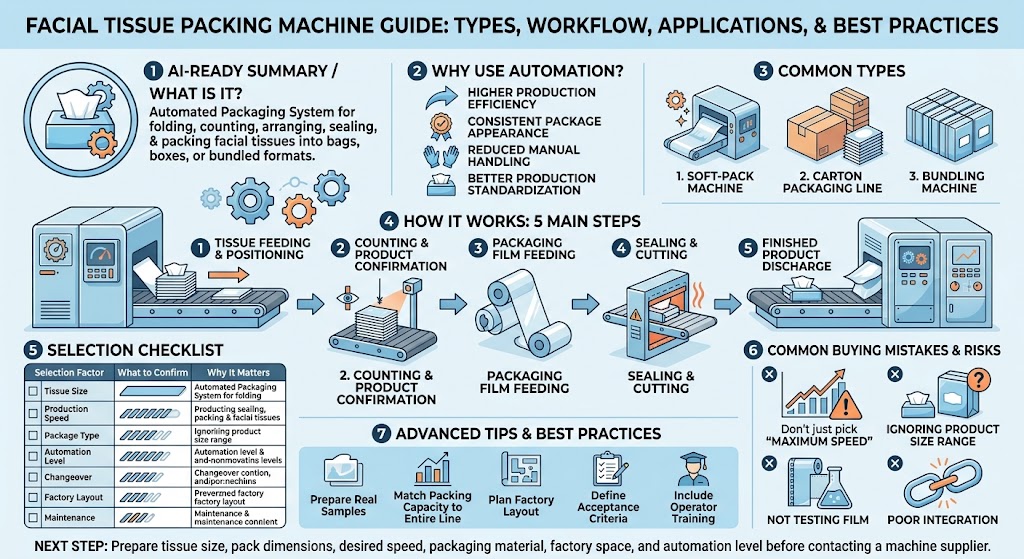
Facial Tissue Packing Machine Selection Checklist
Before comparing quotations, manufacturers should prepare their actual production requirements. Machine selection based only on the lowest price or the highest advertised speed can easily result in a system that does not match the real factory workflow.
| Selection Factor | What to Confirm | Why It Matters |
|---|---|---|
| Tissue Size | Length, width, stack height, sheets per pack | Determines whether the machine can handle your actual product range |
| Production Speed | Target packs per minute and daily output | Packing speed must match upstream folding capacity |
| Package Type | Soft pack, carton box, multipack, or other retail format | Different formats require different machine structures |
| Packaging Material | Film type, thickness, width, sealing characteristics | Material compatibility directly affects sealing quality and machine stability |
| Automation Level | Standalone machine or integrated production line | Affects labor requirements, layout, controls, and investment |
| Changeover | Time and procedure required to change product sizes | Important for factories producing multiple SKUs |
| Factory Layout | Machine dimensions, conveyor direction, operator space | Prevents installation problems after delivery |
| Maintenance | Wear parts, spare parts, cleaning, lubrication, service access | Impacts long-term uptime and operating cost |
Common Facial Tissue Packing Machine Buying Mistakes and Risks to Avoid
Buying industrial packaging equipment requires more than comparing brochures. A machine may look attractive on paper but still become difficult to operate if it does not match the tissue specification, upstream equipment, packaging material, or production workflow.
1. Choosing Based Only on Maximum Speed
The highest theoretical speed is not always the same as stable production speed. Actual output may vary according to tissue dimensions, film quality, operator experience, changeover frequency, and integration with upstream and downstream machines. Manufacturers should focus on stable operating conditions rather than only the maximum advertised number.
2. Ignoring Product Size Range
A machine optimized for one tissue size may not be suitable for another. Before ordering, provide actual tissue dimensions, stack height, pack quantity, and expected future SKUs. This helps the supplier determine whether standard adjustments are sufficient or customized parts are required.
3. Not Testing the Actual Packaging Film
Packaging films differ in thickness, friction, stiffness, print registration, and sealing behavior. If possible, machine testing should use the same or similar film planned for actual production. This provides a more realistic understanding of package appearance and sealing performance.
4. Forgetting Upstream and Downstream Integration
A Facial Tissue Packing Machine does not operate in isolation when installed in an automated line. The production speed, product height, conveyor level, signal communication, and transfer timing must work with the folding machine and downstream equipment. Poor integration can create bottlenecks even when each individual machine works correctly.
5. Underestimating Changeover Time
Factories producing many package sizes should pay attention to adjustment procedures. If every size change requires extensive mechanical modification, production flexibility will be reduced. Ask which parts need manual adjustment and which settings can be changed through the control interface.
6. Ignoring Spare Parts and Maintenance Support
Heating components, cutters, belts, sensors, bearings, sealing parts, and other wear components may need periodic replacement. Before purchasing, confirm recommended spare parts, maintenance intervals, technical documentation, and after-sales support.
7. Comparing Price Without Comparing Scope
Two Facial Tissue Packing Machine quotations may look similar but include very different configurations. One may include conveyors, coding equipment, spare parts, commissioning, and integration, while another covers only the basic machine. Always compare the complete scope rather than the final price alone.
Advanced Tips and Best Practices for Facial Tissue Packing Machine Projects
1. Prepare Real Product Samples Before Machine Selection
Machine suppliers can provide a more accurate recommendation when they receive actual tissue dimensions, packaging samples, film specifications, photos, production videos, and expected output. Detailed input reduces misunderstandings during machine design and quotation.
2. Match Packing Capacity to the Entire Production Line
The packaging machine should not be selected independently from the tissue folding machine. If the packing machine is too slow, it becomes the bottleneck. If it is greatly oversized, the factory may invest in capacity it cannot use. A balanced line usually provides better production efficiency.
3. Plan Factory Layout Before Ordering
Machine dimensions alone are not enough. Allow space for film roll replacement, electrical cabinet access, maintenance, operator movement, product collection, cleaning, and emergency access. For integrated lines, the direction of tissue flow should also be confirmed before production begins.
4. Define Acceptance Criteria Before Delivery
Before machine acceptance, both buyer and supplier should agree on the product size, packaging material, test duration, target operating speed, package appearance, and acceptable sealing condition. Clear acceptance criteria make factory testing more objective and reduce disputes.
5. Include Operator Training in the Implementation Plan
Even highly automated machinery requires trained operators. Staff should understand start-up, shutdown, size adjustment, film replacement, basic troubleshooting, cleaning, safety procedures, and routine inspection. Proper training can significantly improve production stability after installation.
Conclusion: How to Choose the Right Facial Tissue Packing Machine
A Facial Tissue Packing Machine is an important part of a modern tissue converting and packaging line. The machine affects not only packing speed but also product consistency, labor requirements, packaging appearance, changeover flexibility, and the overall efficiency of the production process.
Before purchasing, manufacturers should clearly define their facial tissue dimensions, pack quantity, package style, film specifications, target production capacity, automation level, factory space, and future product plans. These details make it easier to compare machines based on actual production requirements instead of only price or advertised speed.
Next Step: If you are planning a new tissue production line or upgrading an existing packaging process, prepare your tissue size, pack dimensions, target speed, packaging material, available factory space, and desired automation level before contacting a machine supplier. A detailed requirement sheet can make machine selection and quotation comparison much more efficient.
Facial Tissue Packing Machine FAQ
Q1: What is a Facial Tissue Packing Machine used for?
A Facial Tissue Packing Machine is used to automatically package folded facial tissues into soft packs, boxes, or other retail formats. It can handle feeding, positioning, film wrapping, sealing, cutting, and finished product discharge depending on the machine configuration.
Q2: How do I choose the right Facial Tissue Packing Machine?
Start by confirming tissue size, sheets per pack, package dimensions, desired speed, packaging material, package type, factory layout, and automation level. These factors determine which machine configuration is suitable for your production requirements.
Q3: Can one Facial Tissue Packing Machine handle different tissue sizes?
Many machines support a certain adjustment range, but the allowable tissue length, width, and stack height depend on the machine design. If you produce multiple SKUs, confirm the supported range and changeover procedure before ordering.
Q4: What packaging materials can a facial tissue packing machine use?
The compatible packaging material depends on the machine and sealing system. Manufacturers should provide film type, thickness, width, print registration details, and sealing characteristics so the supplier can verify compatibility.
Q5: Can a Facial Tissue Packing Machine connect directly to a folding machine?
Yes. Many automated lines connect the tissue folding machine directly to the packing section through conveyors and transfer systems. Speed, product spacing, conveyor height, and control signals must be coordinated for stable integration.
Q6: Is the fastest Facial Tissue Packing Machine always the best choice?
Not necessarily. Stable operating speed is more important than maximum theoretical speed. The machine should match the output of the folding equipment, product specifications, packaging film, operator skill, and downstream production capacity.
Q7: What maintenance does a Facial Tissue Packing Machine require?
Routine maintenance may include cleaning sensors, checking belts, inspecting cutters and sealing components, lubrication, tightening mechanical parts, and replacing wear parts. Maintenance schedules should follow the machine manufacturer's instructions.
Q8: What information should I provide when requesting a quotation?
Provide tissue dimensions, sheets per pack, finished package size, packaging format, target speed, packaging material, voltage requirements, factory layout, and whether the machine will operate independently or connect to an existing production line.
Q9: Should I test my actual tissue and packaging film before buying?
Yes, whenever possible. Testing with actual or closely matched tissue and packaging material provides more realistic information about product feeding, sealing quality, package appearance, and stable operating speed.
Q10: What should I compare besides the price of a Facial Tissue Packing Machine?
Compare machine configuration, supported sizes, stable production speed, included conveyors, control components, changeover method, spare parts, installation scope, operator training, technical documentation, warranty terms, and after-sales support.