
- 日期:2026-08-13
- 分類:工業工程
What Are Screws and Why Does Screw Type Matter?
Screws are threaded fasteners designed to join two or more components by converting rotational force into clamping force. Although screws may look similar at first glance, their thread geometry, head design, drive type, point shape, material, coating, diameter, and length can dramatically affect installation performance and long-term reliability.
For a buyer, engineer, manufacturer, contractor, or product designer, selecting screws is not simply a matter of choosing the correct length. A screw that performs well in a threaded steel housing may be a poor choice for thin sheet metal. Likewise, a screw designed to cut its own thread into plastic may not provide the repeatable assembly characteristics required for machinery that must be opened and serviced frequently.
The main question is therefore not “Which screws are best?” but “Which screws are best for this specific material, assembly method, load condition, environment, and maintenance requirement?” This comparison guide focuses on two widely used categories—machine screws and self-tapping screws—while also explaining other common screw types, material options, cost factors, and purchasing considerations.
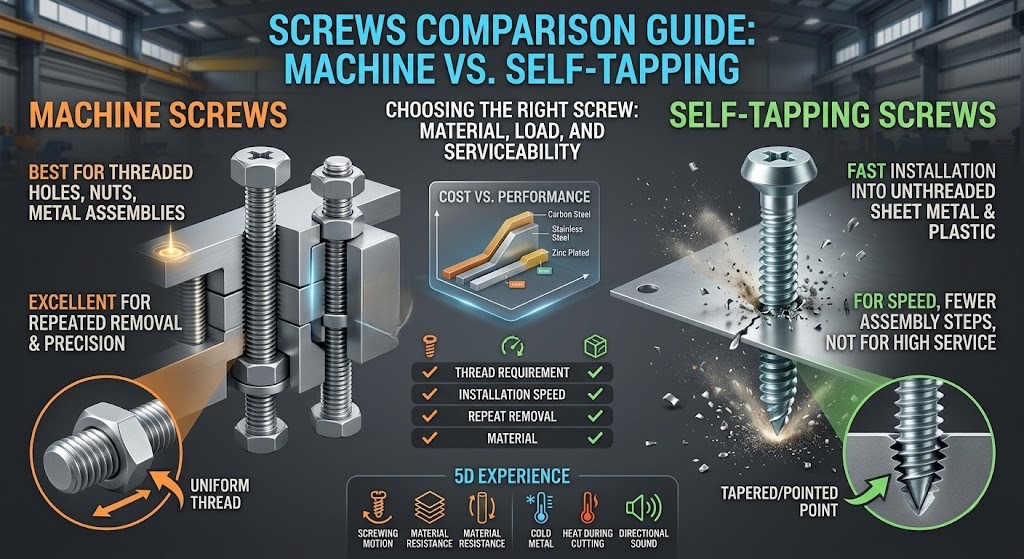
Quick conclusion: Choose machine screws when you need precise reusable fastening into a nut or pre-threaded hole. Choose self-tapping screws when you want faster assembly and do not already have internal threads in the receiving material.
Machine Screws vs Self-Tapping Screws: Key Differences
Machine screws and self-tapping screws are both widely used in industrial production, electronics, appliances, metal fabrication, automotive parts, furniture, and equipment manufacturing. However, they serve different assembly strategies. The table below provides a practical comparison.
| Comparison Item | Machine Screws | Self-Tapping Screws | Best For |
|---|---|---|---|
| Thread Requirement | Normally requires a nut or pre-threaded hole | Creates or forms its own mating thread during installation | Depends on whether the receiving part already has threads |
| Installation Speed | Moderate, especially if tapping is required first | Usually faster in production assembly | Self-tapping for rapid installation |
| Repeat Removal | Generally better for repeated disassembly and reassembly | Repeated removal may gradually weaken formed threads in softer materials | Machine screws for serviceable products |
| Material Compatibility | Metal assemblies, machinery, electronics, precision components | Sheet metal, plastic, thin sections, enclosures | Match screw type to base material |
| Assembly Preparation | May need tapping, threaded inserts, or nuts | Often reduces separate tapping operations | Self-tapping for fewer assembly steps |
| Precision | Well suited to standardized threaded systems | Performance depends strongly on pilot hole and material thickness | Machine screws for highly controlled assemblies |
| Production Efficiency | Good when mating threads are already part of the design | Excellent when eliminating a separate tapping operation matters | Self-tapping for high-speed assembly lines |
| Typical Cost Logic | Fastener may be simple, but assembly preparation can add cost | May reduce process cost even if screw unit price is higher | Compare total assembly cost, not only screw price |
When Machine Screws Make More Sense
Machine screws are usually the better option when the mating component already has internal threads or when the design uses nuts, threaded inserts, weld nuts, or tapped holes. They are especially useful in products requiring controlled assembly torque and repeated servicing. Electronics housings, machinery covers, brackets, automotive modules, control panels, and industrial equipment frequently rely on machine screws because the mating thread geometry can be standardized and inspected.
When Self-Tapping Screws Make More Sense
Self-tapping screws are attractive when manufacturers want to reduce assembly steps. Instead of drilling and tapping a finished internal thread, the screw itself creates or forms the thread during installation. This can be particularly useful in sheet metal enclosures, HVAC components, appliance housings, automotive trim, plastic parts, and light fabrication. However, pilot hole size, material hardness, thickness, and installation torque must be controlled carefully.
Common Types of Screws and Where They Are Used
The keyword “screws” covers a very broad product category. A buyer should not assume that all screws with the same diameter and length are interchangeable. Thread form and point geometry can be just as important as size.
Machine Screws
Machine screws typically have a uniform thread and are designed to mate with a nut or tapped hole. Common head styles include pan head, flat head, round head, truss head, and socket styles. They are widely used in mechanical assemblies, electrical equipment, instrumentation, metal brackets, control systems, and consumer products.
Self-Tapping Screws
Self-tapping screws form or cut mating threads as they are installed. They are commonly selected for sheet metal and some plastics. Proper pilot hole dimensions are critical: a hole that is too small can increase driving torque or cause cracking, while a hole that is too large can reduce pull-out strength.
Self-Drilling Screws
Self-drilling screws combine drilling and fastening in one operation. Their drill-shaped point can penetrate certain metal sections without a separate pre-drilling step. These screws are frequently used in metal roofing, steel framing, cladding, ducts, and construction assemblies where installation speed is important.
Wood Screws
Wood screws typically use coarse threads that provide strong engagement in timber and engineered wood products. The thread design, shank configuration, head shape, and point geometry vary depending on whether the application is furniture, cabinetry, structural timber, decking, or general woodworking.
Socket Screws
Socket screws use an internal hex or similar drive and are common in machinery, automation systems, molds, fixtures, and industrial equipment. They are often selected when designers need compact head geometry, higher tightening torque, or a professional mechanical appearance.
3 Buying Scenarios: Which Screws Fit Your Needs?
Scenario 1: First-Time Buyer or General-Purpose Assembly
If you are a first-time buyer, begin with the mating material and installation method. If the receiving part already has internal threads, choose machine screws. If the screw needs to create a thread in sheet metal or plastic, evaluate self-tapping screws. Do not select based only on appearance or diameter. Confirm thread standard, length, head type, drive, material, and finish before ordering.
Scenario 2: Cost-Conscious Production
For production buyers focused on cost, compare total installed cost rather than the purchase price of screws alone. A self-tapping screw may reduce secondary tapping operations, labor time, tooling, and handling. On the other hand, if your components are already machined with standardized threaded holes, machine screws may provide better repeatability and easier servicing with little additional process cost.
Scenario 3: Performance, Reliability, and Serviceability First
For machinery, industrial equipment, test instruments, automotive modules, or products that will be opened repeatedly, machine screws used with durable threaded features are usually preferable. They offer more predictable reassembly and are easier to specify using standardized thread systems. If environmental exposure is significant, also consider stainless steel, corrosion-resistant coatings, locking features, and compatible mating materials.
Screw Materials and Finishes Compared
Even after choosing the correct type of screws, material and surface treatment can determine whether the assembly survives corrosion, vibration, moisture, chemical exposure, or long-term outdoor use.
| Material / Finish | Main Characteristics | Typical Applications | Key Consideration |
|---|---|---|---|
| Carbon Steel | Cost-effective and widely available | General machinery, appliances, indoor assemblies | Often needs protective plating or coating |
| Stainless Steel | Good corrosion resistance | Food equipment, marine-related environments, outdoor products | Grade selection still matters |
| Zinc-Plated Steel | Common protective finish with economical cost | Indoor and light-duty industrial use | Not automatically suitable for severe environments |
| Black Oxide | Dark appearance, limited corrosion protection by itself | Machinery, tools, appearance-sensitive assemblies | May require oil or additional protection |
| Brass | Decorative, conductive, and corrosion-resistant in many indoor uses | Electrical components, furniture, decorative hardware | Lower strength than many steel options |
What Affects the Cost of Screws?
The cost of screws can vary considerably even when two products appear similar. Procurement teams should compare the complete specification rather than only unit price. The following factors commonly create price differences.
- Material: carbon steel, stainless steel, brass, alloy steel, and specialty materials have different raw-material costs.
- Size: diameter, length, thread pitch, and head geometry affect material usage and manufacturing difficulty.
- Surface finish: zinc plating, black oxide, passivation, nickel plating, and specialized corrosion-resistant coatings add process steps.
- Heat treatment: some screws require controlled hardness and mechanical properties.
- Drive and head style: standard designs are generally easier to source than custom geometries.
- Quality requirements: tighter dimensional tolerance, inspection reports, lot traceability, and testing increase quality-control costs.
- Order quantity: production volume affects tooling, setup cost, packaging, and per-piece economics.
- Custom manufacturing: non-standard threads, special points, custom recesses, or proprietary dimensions may require dedicated tooling.
For OEM and industrial purchasing, the cheapest screws are not necessarily the lowest-cost solution. A screw that causes stripped threads, assembly delays, rework, corrosion complaints, or field failures can become much more expensive than a properly specified fastener.
6 Common Screw Selection Mistakes to Avoid
- Choosing only by diameter and length: thread pitch, point type, head style, and drive type also matter.
- Ignoring the receiving material: screws for steel, aluminum, plastic, and wood are not automatically interchangeable.
- Using self-tapping screws without checking pilot hole size: this can cause high torque, stripping, poor retention, or cracking.
- Focusing only on unit price: total assembly cost and failure risk are more important than fastener price alone.
- Using the wrong finish for the environment: indoor coatings may not be suitable for moisture, salt, chemicals, or outdoor exposure.
- Changing suppliers without checking specifications: screws with similar descriptions can still differ in hardness, dimensions, coating thickness, and mechanical performance.
How to Select the Right Screws Step by Step
Step 1: Identify the Base Material
Determine whether the screws will fasten steel, aluminum, plastic, wood, composite material, or a combination of materials. Material thickness and hardness are particularly important for self-tapping screws.
Step 2: Decide Whether a Mating Thread Already Exists
If the component already contains a tapped hole, threaded insert, or nut, machine screws are usually appropriate. If there is no internal thread and you want the fastener to create one, investigate self-tapping or self-drilling screws.
Step 3: Confirm Diameter, Length, and Thread
Check the required screw diameter, total length, thread pitch, thread engagement, and whether the application follows metric or inch standards. Never assume that two screws of similar visual size have interchangeable threads.
Step 4: Select the Head and Drive Style
Choose the head based on clearance, appearance, load distribution, and whether the head should sit flush with the surface. Drive style should consider available tools, torque requirements, assembly speed, and resistance to cam-out.
Step 5: Check Strength and Environmental Requirements
Determine whether the screws need specific mechanical properties, corrosion resistance, temperature resistance, vibration resistance, or electrical characteristics. This is especially important in industrial, outdoor, automotive, marine, and food-processing applications.
Step 6: Evaluate Assembly and Maintenance
Ask whether the product will be assembled once or opened repeatedly. For repeated service, durable machine-threaded joints often have an advantage. For high-volume production where assembly speed matters, self-tapping or self-drilling solutions may reduce process steps.
Step 7: Request Samples Before Large-Volume Orders
For OEM or production applications, sample testing can reveal issues that drawings alone may not show. Evaluate installation torque, thread engagement, head seating, pull-out performance, appearance, corrosion requirements, and compatibility with automated screw-driving equipment before committing to a major order.
Screws FAQ: 10 Common Questions Before You Buy
Q1: What is the main difference between machine screws and self-tapping screws?
Machine screws normally fasten into an existing threaded hole or nut, while self-tapping screws create or form their mating thread during installation. Machine screws are often preferred for reusable precision assemblies, while self-tapping screws are useful for faster assembly into suitable unthreaded materials.
Q2: Are self-tapping screws better than machine screws?
Not universally. Self-tapping screws are better when rapid installation into unthreaded material is the priority. Machine screws are generally better when the assembly already has threaded features or needs repeated removal and reinstallation.
Q3: How much do screws cost?
The cost of screws depends on material, dimensions, thread type, head style, coating, heat treatment, quality requirements, order quantity, packaging, and whether the screws are standard or custom-made. Industrial buyers should compare total assembly cost rather than unit price alone.
Q4: Which screws are best for sheet metal?
Self-tapping screws and self-drilling screws are commonly used for sheet metal. The correct choice depends on sheet thickness, material hardness, pilot hole requirements, load, installation speed, and whether the screw must drill through the material itself.
Q5: Which screws are best for repeated assembly and disassembly?
Machine screws used with durable internal threads, nuts, or threaded inserts are generally better for products that need repeated servicing. Repeatedly removing self-tapping screws from softer materials can gradually reduce thread holding strength.
Q6: How long does it take to manufacture custom screws?
Lead time for custom screws depends on tooling, material availability, forming complexity, heat treatment, surface finishing, inspection requirements, sample approval, and order quantity. Standard catalog screws are usually available faster than fully customized fasteners.
Q7: What are the disadvantages of self-tapping screws?
Their performance is sensitive to pilot hole size, material thickness, installation torque, and base-material strength. In softer materials, repeated removal can weaken the formed threads. They may also be less suitable than machine screws for highly serviceable precision assemblies.
Q8: What are the disadvantages of machine screws?
Machine screws normally require an existing mating thread, nut, or threaded insert. If the receiving component is not already threaded, additional tapping or hardware may increase production steps, tooling requirements, and assembly cost.
Q9: Should I choose stainless steel or zinc-plated screws?
Stainless steel screws are often selected when corrosion resistance is a higher priority, while zinc-plated steel screws can be a cost-effective choice for many indoor or moderately protected environments. The final choice should reflect exposure conditions, strength requirements, mating materials, and budget.
Q10: What information should I provide when requesting a quote for screws?
Provide the screw type, thread specification, diameter, length, head style, drive type, material, surface finish, mechanical requirements, quantity, application, packaging requirements, drawing or sample if available, and any inspection or certification needs.